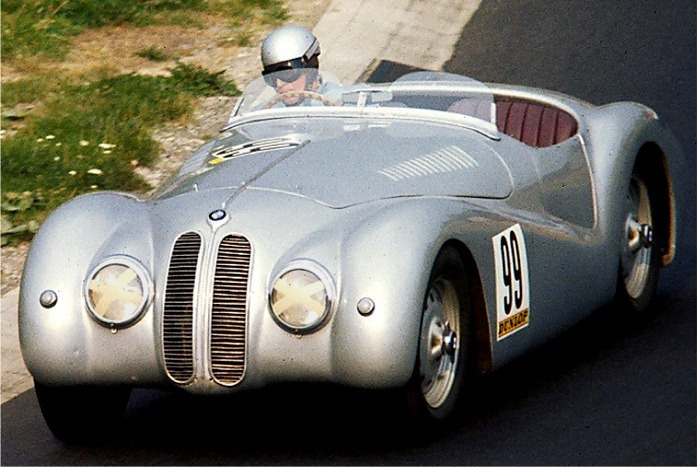
BMW 328
The BMW 328 is arguably the most important sports car produced before World War II and one of the most influential automobiles in history. Introduced in 1936, the 328 dominated international motorsport for the next four years with a remarkable record that included class victories at virtually every major race in Europe, culminating in an outright win at the 1940 Mille Miglia.
The key to the 328's success was its engine, a 2.0-liter inline-six that featured an innovative cross-pushrod operated hemispherical combustion chamber head. Rather than the complex and expensive overhead camshaft design used by competitors, BMW engineer Rudolf Schleicher devised a system where a single camshaft in the block operated intake valves directly and exhaust valves through an ingenious crossover pushrod system. This gave the 328 the breathing benefits of a hemispherical head without the weight and complexity of overhead cams. The result was 80 hp from just under two liters -- an exceptional figure for the era.
The chassis was equally innovative. A tubular steel frame provided a rigid yet lightweight structure, weighing just 830 kg (1,830 lbs) complete. The independent front suspension used transverse leaf springs and wishbones, while hydraulic brakes on all four wheels provided stopping power that was superior to many of its competitors. The body was a flowing, aerodynamic design that was both beautiful and functional.
The 328's racing record is extraordinary. It won its class at the Eifelrennen on its competition debut in June 1936 and went on to dominate the 2-liter class across Europe. The car won the Tourist Trophy at the Ards Circuit in Belfast, the RAC Rally, and numerous other events. The crowning achievement came at the 1940 Mille Miglia (run as a closed-circuit race due to wartime conditions), where a specially bodied 328 with a streamlined Touring Superleggera body won overall -- not just its class, but outright against all competitors.
Between 1936 and 1940, BMW produced 464 examples of the 328, including both road and racing versions. The car was assembled at BMW's Eisenach factory in Thuringia. After the war, the factory fell within the Soviet occupation zone and eventually became the basis for the EMW (Eisenacher Motorenwerk) and later Wartburg brands.
The 328's legacy extends far beyond its own production run. After the war, the engine design was studied by the British and influenced the development of the Bristol 400 and the Frazer Nash Le Mans Replica, both of which used derivatives of the BMW engine. The cross-pushrod head design also influenced other manufacturers.
Today, the BMW 328 is one of the most sought-after pre-war sports cars. With only 464 built and many lost during the war, surviving examples are extremely rare. Prices reflect this scarcity, with good examples commanding $700,000 to $1.5 million, and exceptional Mille Miglia or racing-history cars significantly more. The 328 is eligible for the most prestigious historic racing and concours events worldwide, including the Mille Miglia Storica and Pebble Beach Concours d'Elegance.
With only 464 built and many lost during WWII, acquiring a genuine 328 requires patience and significant capital. Full provenance documentation is essential. Pre-war BMW records are incomplete, so specialist organizations like the BMW 328 Register are important resources. Many components were shared with other pre-war BMWs. Reproduction parts are available for common wear items. Racing history adds significant value. Any 328 purchase should involve a specialist in pre-war BMWs.
Built at BMW's Eisenach factory in Thuringia from 1936 to 1940. Total production was 464 units. The Eisenach factory was later absorbed into the Soviet occupation zone after WWII. Various body styles were produced, including the standard roadster, Touring Superleggera streamlined body (for racing), and special coachwork by Wendler and others.