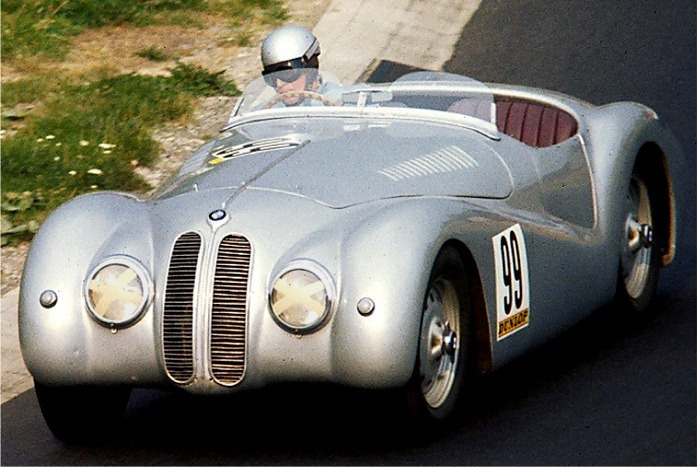
BMW 328 Roadster Mille Miglia
The BMW 328, produced from 1936 to 1940, is widely regarded as the most important sports car of the pre-war era and one of the most significant automobiles in BMW's history. Its innovative engine design, lightweight construction, and outstanding aerodynamics combined to create a car that dominated international motorsport in the late 1930s, establishing engineering principles that would influence automotive design for decades.
The engine was the 328's most revolutionary feature. Chief engineer Rudolf Schleicher developed an ingenious hemispherical combustion chamber head for BMW's 2.0-liter inline-six that used an innovative cross-pushrod system to actuate intake and exhaust valves on opposite sides of the chamber. This arrangement achieved the breathing efficiency of an overhead-cam design using the simpler and more reliable pushrod architecture. The result was 80 horsepower from 2.0 liters — exceptional specific output for the era — delivered with remarkable smoothness and reliability.
The tubular chassis was both light and rigid, supporting a beautiful body designed by Peter Szymanowski at BMW's Eisenach facility. The distinctive kidney grille, set into a gracefully shaped nose, established a design language that BMW would carry forward to the present day. The body's aerodynamic efficiency was remarkably good for the period, with smooth surfaces and integrated headlights contributing to a drag coefficient superior to most contemporaries.
On the racetrack, the 328 was devastatingly effective. It won its class at Le Mans in 1939, and a specially bodied 328 with a Carrozzeria Touring Superleggera streamlined body won the 1940 Mille Miglia outright — a victory in the last running of the famous race before World War II halted motorsport activities. The 328 also competed successfully in rallies, hillclimbs, and circuit races throughout Europe, achieving a competitive record that few pre-war sports cars could match.
Driving a 328 was a revelation for its era. The independent front suspension — unusual for the time — provided far better steering precision and ride quality than the beam axles used by most competitors. The hydraulic brakes (also uncommon) offered consistent, progressive stopping power. The four-speed gearbox was among the best available, and the overall driving experience set a standard for sports car behavior that would not be surpassed until well after the war.
Only 464 examples were produced before World War II ended production, and attrition from the war years, racing damage, and the passage of time has reduced the number of survivors significantly. The 328's engineering innovations — particularly the hemispherical combustion chamber head — influenced post-war designs by Bristol, Frazer Nash, and others who had access to BMW's wartime engineering data.
Today, the 328 is universally recognized as one of the greatest sports cars of all time. Survivors are extraordinarily valuable, with Mille Miglia and Le Mans provenance cars commanding the highest prices. The BMW 328 represents a pinnacle of pre-war automotive engineering that established BMW as a maker of sporting machines par excellence.
Authentic BMW 328s are among the most valuable pre-war sports cars. Thorough provenance verification is essential — many reproductions exist. The engine's cross-pushrod system requires specialist knowledge to maintain. Check for chassis frame corrosion and accident repair. Original body panels in the correct gauge aluminum or steel should be verified. The Mille Miglia Touring-bodied cars are the most valuable variants. Any purchase should involve a recognized pre-war BMW specialist.
464 BMW 328s were produced between 1936 and 1940 at BMW's Eisenach facility (which after the war became part of East Germany and produced EMW/IFA vehicles). Special lightweight bodies were created by Carrozzeria Touring (Mille Miglia) and Wendler. The innovative cross-pushrod hemispherical head design influenced Bristol and Frazer Nash post-war designs. After WWII, the 328 engine technology was studied and copied by several manufacturers.