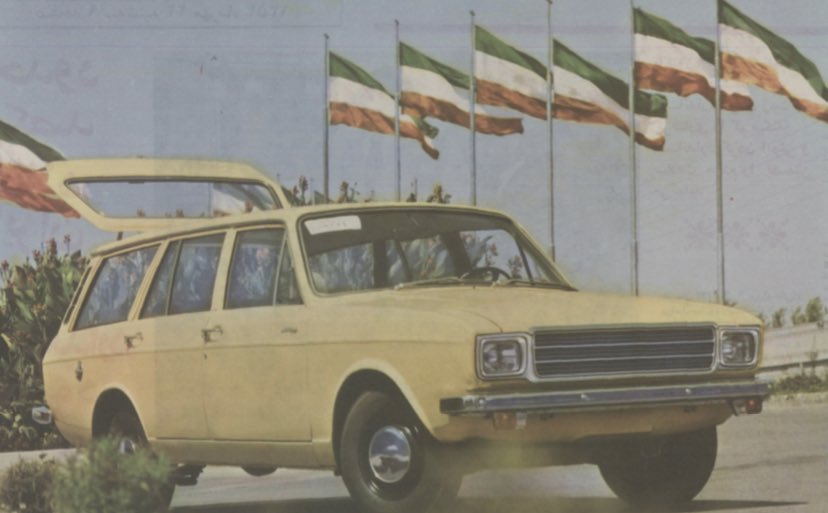
Iran Khodro Paykan Deluxe
The Paykan (Persian for 'Arrow') is Iran's most iconic automobile — a Hillman Hunter-based sedan that was produced for an extraordinary 38 years, becoming the very definition of Iranian motoring and an integral part of the country's cultural landscape.
The story begins in the late 1960s when the Rootes Group (later Chrysler UK) licensed the Hillman Hunter design to Iran National Industrial Manufacturing Company, which would later become Iran Khodro, the Middle East's largest car manufacturer. Production began in Tehran in 1967, initially as CKD assembly and gradually transitioning to full local manufacture.
The Paykan used the Hillman Hunter's 1.7-liter OHV four-cylinder engine, four-speed manual gearbox, and MacPherson strut front suspension. The body was initially identical to the Hunter, but as local content increased, Iranian engineers made adaptations for local conditions — simplified electrical systems, improved cooling, and modifications for Iranian fuel quality.
The Paykan served Iran through the most turbulent period of its modern history — the final years of the Shah's regime, the Islamic Revolution of 1979, the devastating Iran-Iraq War (1980-1988), and the subsequent periods of reconstruction and reform. Through it all, the Paykan remained the default car of Iranian life.
During international sanctions, when foreign cars were unavailable, the Paykan's importance was magnified. Millions of Iranians relied on it for transportation, and a vast network of small workshops kept aging Paykans running with hand-made replacement parts and ingenious repairs.
The Paykan was also produced in pickup truck and van variants, serving commercial and agricultural roles. Orange Paykan taxis were as characteristic of Tehran's streets as yellow cabs are of New York.
Production finally ended in 2005 when environmental regulations and modernization pressures led to its retirement. Iran Khodro transitioned to producing the Peugeot 405-derived Samand and other more modern vehicles.
The Paykan remains deeply embedded in Iranian culture. It appears in Iranian films, literature, and art, and it represents an era of self-reliance and resourcefulness. For Iranians abroad, the Paykan evokes powerful nostalgia for home.
Very common in Iran but rare outside the country due to export restrictions and sanctions. Parts availability is excellent within Iran through the vast network of Paykan workshops. The car is simple to maintain and repair. Outside Iran, the Hillman Hunter parts network provides some compatibility. Check for rust, engine wear, and suspension condition. Orange former-taxi examples are available but typically heavily worn. Clean, low-mileage private-use examples are more desirable.
Produced at Iran Khodro, Tehran from 1967 to 2005. Based on Hillman Hunter (Rootes Group/Chrysler UK). Gradually transitioned from CKD assembly to full local manufacture. Variants: sedan, pickup truck, van. Orange taxis were ubiquitous in Tehran. Estimated total production exceeds 2 million units.