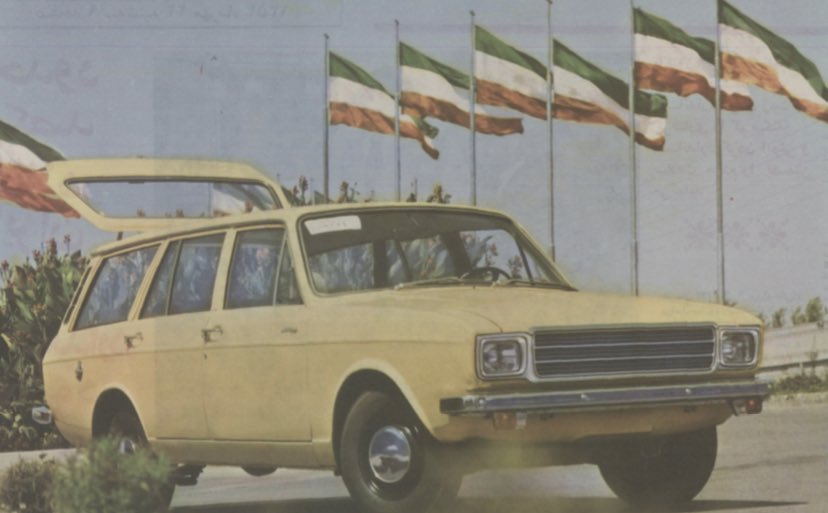
Iran Khodro Paykan Standard
The Iran Khodro Paykan, meaning 'Arrow' in Farsi, was produced from 1967 to 2005 and is the most culturally significant automobile in Iranian history. Based on the British Hillman Hunter, the Paykan was manufactured by Iran Khodro (formerly Iran National Industrial Manufacturing Company) in Tehran and became Iran's defining vehicle, serving as family car, taxi, and workhorse for nearly four decades.
The Paykan's origins lay in a licensing agreement between Iran National and the Rootes Group (later Chrysler UK) in the mid-1960s. The Hillman Hunter was a modern, well-regarded car when the agreement was signed, and initial production used CKD kits from the UK. Over time, local content increased until the Paykan was entirely Iranian-made, though the fundamental design changed very little.
The 1.7-liter four-cylinder engine, derived from the Hillman unit, produced approximately 68 horsepower. While modest, this was sufficient for Iranian road conditions and provided reasonable fuel economy. The robust construction and simple mechanicals made the Paykan ideal for a country where dealership networks were limited and local mechanics needed to be able to service the car with basic tools.
The Paykan became Iran's de facto national car through a combination of government protection, cultural attachment, and practical necessity. High import tariffs and manufacturing restrictions meant the Paykan faced little competition in the Iranian market. Over time, the car became deeply embedded in Iranian society, appearing in films, literature, and everyday conversation.
As a taxi, the Paykan was ubiquitous in Iranian cities. The orange-and-white Tehran taxis were as much a part of the city's identity as the famous mosques and bazaars. The car's durability in heavy traffic and its ability to absorb the punishment of daily taxi service made it the preferred vehicle for this demanding role.
The Paykan's 38-year production run saw it survive the Islamic Revolution, the Iran-Iraq War, and massive social and economic changes. Through it all, the car remained the constant, reliable presence on Iranian roads. Later models received minor updates including a Peugeot-derived engine and improved safety features, but the basic design remained recognizable throughout.
Production finally ended in 2005, replaced by more modern Iran Khodro models based on Peugeot designs. The Paykan's retirement was mourned by many Iranians who had grown up with the car and considered it a friend rather than mere transportation. Today, the Paykan is recognized as one of the most important vehicles in Middle Eastern automotive history.
Most surviving Paykans are in Iran, with some examples in the Iranian diaspora community. The Hillman-derived mechanicals are simple and repairable. Check for extensive body rust. Later Peugeot-engine models are more reliable. Parts are still available in Iran through a large aftermarket. Export from Iran can be complicated. Original Hillman Hunter parts may be compatible with early models. Taxi-history examples are common but may have high mileage.
Based on the Hillman Hunter through a licensing agreement with the Rootes Group. Produced at Iran Khodro's Tehran factory from 1967 to 2005. Initially assembled from UK-supplied CKD kits, later entirely locally manufactured. Later models received a Peugeot 504-derived engine. Production exceeded several million units over 38 years. Available as sedan, pickup, and van.