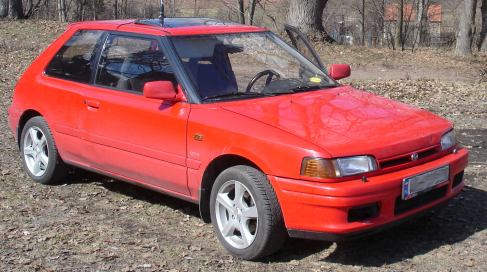
Mazda 323 GTX Turbo 4WD
The Mazda 323 GTX, known as the Familia GT-X in Japan, was a turbocharged all-wheel-drive hot hatchback that served as the precursor to the better-known Familia GT-R. Built from 1985 to 1989 on the BF platform, the 323 GTX was Mazda's answer to the burgeoning Group A rally homologation movement and offered a compelling alternative to the established Lancia Delta HF and emerging Japanese rally cars.
Powered by a turbocharged 1.6-liter B6T inline-four engine producing 132 horsepower, the 323 GTX was not the most powerful car in its class, but its light weight of just 1,060 kg gave it an excellent power-to-weight ratio. The IHI turbocharger provided a progressive power delivery that complemented the car's nimble handling characteristics. The engine revved freely and responded well to modifications, making it popular among rally enthusiasts and tuners.
The all-wheel-drive system used a viscous coupling center differential to distribute torque between the front and rear axles. Under normal driving conditions, the system operated primarily as a front-wheel-drive car, but the viscous coupling could progressively transfer up to 50% of torque to the rear wheels when front wheel slip was detected. This system was simpler and lighter than the mechanical differentials used by some competitors, though it lacked the precision of more advanced systems.
In rally competition, the 323 GTX proved its mettle in various national and regional championships. While it never achieved the global profile of the Lancia Delta or the Mitsubishi Galant VR-4 in World Rally Championship events, it was a competitive and reliable platform that helped develop the expertise Mazda would apply to the subsequent Familia GT-R BG8Z.
The handling was sharp and responsive, with quick steering and good chassis balance. The relatively short wheelbase made the car agile in tight corners, while the all-wheel-drive system provided reassuring stability in faster sweeping bends. The suspension was firm but not overly harsh, making the 323 GTX a viable daily driver as well as a weekend performer.
Today, the 323 GTX is one of the more overlooked Japanese performance cars of the 1980s. Survivors are rare, particularly in unmodified condition, and values have been climbing as enthusiasts discover this hidden gem of the rally homologation era. The car represents an affordable entry point into the world of turbocharged AWD Japanese hot hatches that would later be dominated by the Subaru WRX and Mitsubishi Lancer Evolution.
Finding a 323 GTX in any condition is difficult; finding one in good condition is exceptional. Rust is the primary enemy — check floor pans, sills, rear wheel arches, and the area around the rear subframe mounts. The B6T engine is robust but check the turbo for oil smoke and shaft play. The viscous coupling center differential loses effectiveness over time — test for proper AWD engagement on a loose surface. Inspect the timing belt and water pump (interval is 60,000 miles). Many surviving examples have been modified or used as rally cars — determine the vehicle's history carefully. Unmodified, well-maintained examples command the highest prices.
Built at Mazda's Hiroshima plant as a homologation special for Group A rally. The 323 GTX was the predecessor to the more famous Familia GT-R (BG8Z) and shared its basic architecture with the standard Mazda 323/Familia. In the US market, it was sold as the 323 GTX; in Japan as the Familia GT-X; and in some European markets as the 323 4WD Turbo. Production numbers were limited to meet homologation requirements.