
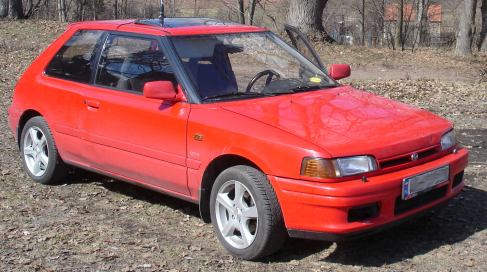
Germany vs Japan — 1984 vs 1985
| Golf GTI Mk2 16V | 323 GTX Turbo 4WD | |
|---|---|---|
| Horsepower | 139 hp | 132 hp |
| Torque | 124 lb-ft | 142 lb-ft |
| Engine Size | 1,781 cc | 1,597 cc |
| 0-60 mph | 8.0 sec | 7.8 sec |
| Top Speed | 129 mph | 121 mph |
| ¼ Mile | 16.0 sec | 15.8 sec |
| Weight | 2,271 lbs | 2,337 lbs |
| Wheelbase | 2,475 mm | 2,400 mm |
| Length | 3,985 mm | 3,990 mm |
| Original MSRP | $12,990 | $12,999 |
| Value (Excellent) | $30,000 | $35,000 |
| Collectibility | 7/10 | 7/10 |
| Rarity | 5/10 | 8/10 |
Two outstanding machines, each with compelling strengths. The 1984 Volkswagen Golf GTI Mk2 16V excels in higher top speed, while the 1985 Mazda 323 GTX Turbo 4WD stands out for quicker acceleration. The best advice? Drive both if you can, then follow your instincts.
Putting the 1984 Volkswagen Golf GTI Mk2 16V against the 1985 Mazda 323 GTX Turbo 4WD is a comparison that enthusiasts have debated for decades. Each car reflects distinct design philosophies shaped by different automotive cultures — Germany versus Japan. On paper, the two are remarkably close in power output, with the 1984 Volkswagen Golf GTI Mk2 16V producing 139 hp and the 1985 Mazda 323 GTX Turbo 4WD delivering 132 hp. Under the hood, the contrast is notable: the Volkswagen Golf GTI uses a Inline-4 DOHC 16V displacing 1,781 cc, while the Mazda 323 GTX relies on a Inline-4 SOHC 8-valve turbo with 1,597 cc. In the sprint to 60 mph, the 1985 Mazda 323 GTX Turbo 4WD edges ahead at 7.8 seconds versus 8.0 seconds. Both trade at comparable values on the collector market, making the choice between them largely one of personal preference.