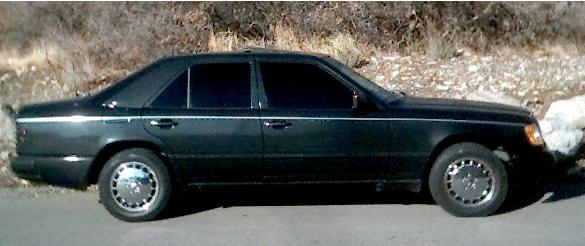
Mercedes-Benz 300E W124
The Mercedes-Benz W124 is, for many enthusiasts and engineers, the greatest sedan Mercedes-Benz ever produced. It was the last Mercedes designed and built during the company's legendary over-engineering era — a time when the goal was to build the best car possible regardless of cost, before the accountants took over in the 1990s.
The 300E, powered by the 3.0-liter M103 inline-six producing 177 hp (DIN), was the sweet spot of the W124 range. The engine was silky smooth, utterly reliable, and provided effortless performance. It wasn't fast by modern standards, but it delivered its power with a refined, unstressed character that made every journey feel special.
What made the W124 extraordinary was its engineering depth. The five-link independent rear suspension, developed at enormous cost, provided both exemplary ride comfort and excellent handling — a combination that most manufacturers still struggle to achieve. The body was assembled with tolerances tighter than contemporary aircraft standards. The paint was applied in multiple thick layers. The wiring harness used aerospace-grade connectors. Even the chrome trim was double-plated.
The result was a car that could routinely cover 300,000 to 500,000 kilometers with basic maintenance, and many examples have exceeded one million kilometers. In Africa and the Middle East, W124s are still used as daily drivers and taxis, a testament to their extraordinary durability.
The W124 was available as a sedan, coupe, cabriolet, wagon (T-model), and even a long-wheelbase version. The range spanned from the four-cylinder 200 to the mighty 500E (built in collaboration with Porsche) and the AMG variants. The 300E represented the ideal balance of performance, economy, and refinement.
The W124 was the last Mercedes built to the philosophy that the car must be better than it needs to be. Its successor, the W210 E-Class, introduced cost-cutting measures that resulted in rust and reliability issues that would have been unthinkable in a W124. Today, good W124 300Es are increasingly valued by enthusiasts who recognize them as the last of the truly over-engineered Mercedes sedans.
The W124 is one of the most durable cars ever built, but neglected examples can be expensive to restore to proper condition. Rust is relatively rare but check the lower fenders, inner wheel arches, and floor pans. The M103 engine is bulletproof with regular oil changes. The automatic transmission is reliable but fluid and filter changes are essential. Wiring harness degradation (biodegradable insulation on some models) is a known issue — affected harnesses should be replaced. Head gasket on the M103 can weep oil. Later M104 24-valve cars are faster but slightly less reliable. Avoid cars with deferred maintenance — catching up on Mercedes service is expensive.
Approximately 2.7 million W124s produced across all body styles (1984-1997). The 300E was the most popular six-cylinder variant. A mid-cycle update in 1989/90 introduced the M104 24-valve engine (300E-24, 220 hp). In 1993, the naming convention changed to E 300 under the new E-Class branding. The W124 coupe and cabriolet continued until 1997. The legendary 500E (built by Porsche) used a 5.0-liter V8.