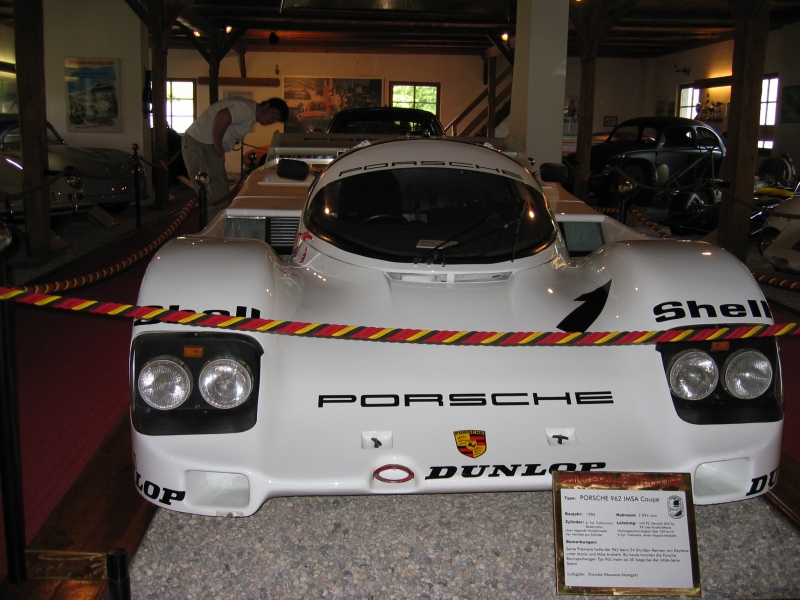
Porsche 962 Dauer 962 Le Mans
The Dauer 962 Le Mans is one of the most remarkable vehicles in motorsport and automotive history — a genuine Le Mans-winning race car that also carried license plates for road use. Created by German racing engineer Jochen Dauer, who modified Porsche's iconic 962 Group C prototype into a road-legal supercar, the Dauer 962 LM exploited a regulation loophole at the 1994 24 Hours of Le Mans to spectacular effect.
The story begins with Porsche's 962, one of the most successful endurance racing cars ever built. Between 1984 and 1991, the 962 dominated Group C racing, winning Le Mans, Daytona, and countless other endurance classics. Its twin-turbocharged flat-six engine, derived from the production 930 Turbo, proved both devastatingly fast and remarkably reliable — the essential combination for endurance success.
When Group C regulations ended, Jochen Dauer saw an opportunity. He acquired several 962 chassis and set about converting them for road use, adding headlights, turn signals, a passenger seat, air conditioning, and the minimal equipment required for German TUV road certification. Crucially, these modifications qualified the car as a 'production' vehicle under FIA rules, allowing it to compete at Le Mans in the GT1 class rather than the highly restricted prototype categories.
The Le Mans organizers, recognizing the potential for exploitation, required Dauer to demonstrate that the cars were genuinely road-legal. Dauer complied, and the Dauer 962 LM was accepted for the 1994 race. With Yannick Dalmas, Hurley Haywood, and Mauro Baldi sharing driving duties, a Dauer 962 LM won the 1994 24 Hours of Le Mans outright — effectively a purpose-built prototype racing car disguised as a road car beating the actual prototypes at their own game.
The road-going Dauer 962 produced approximately 730 horsepower from its 3.0-liter twin-turbocharged flat-six, channeled through a six-speed manual gearbox to the rear wheels. Performance was staggering — a claimed top speed of over 400 km/h and 0-100 km/h in under 3 seconds placed it among the fastest road cars ever created. The Le Mans-proven ground-effect aerodynamics generated enormous downforce, allowing cornering speeds that would be dangerous in any car not designed for Le Mans.
Only thirteen Dauer 962 Le Mans road cars were produced, making it one of the rarest and most exclusive road-legal vehicles ever built. Each required hundreds of hours of hand assembly and modification from the base 962 racing chassis. The car remains a testament to one man's ingenuity, Porsche's engineering excellence, and the sometimes blurry line between racing cars and road cars.
The Dauer 962 LM's Le Mans victory led to significant rule changes, with organizers introducing strict homologation requirements to prevent similar exploitation in the future. It was the last time a car with such a direct connection to a pure racing prototype won the 24 Hours outright.
Extremely rare — only 13 examples exist. Full provenance documentation and Dauer Sportwagen records are essential. These are essentially race cars with road-legal modifications, requiring specialist maintenance. The twin-turbo flat-six requires regular turbocharger inspection and rebuild. Carbon brake systems need careful inspection. Ground-effect aerodynamics must be maintained to original specification for safety. Verify road-legal equipment is complete and functional for registration purposes.
Jochen Dauer converted approximately 13 Porsche 962 race chassis into road-legal specification between 1993 and 1999. The 1994 Le Mans-winning car (chassis 962-145) was technically different from the road cars, with less sound deadening and comfort equipment. The conversion included headlights, turn signals, raised ride height, silenced exhaust, air conditioning, and a passenger seat. Porsche officially sanctioned the conversions.