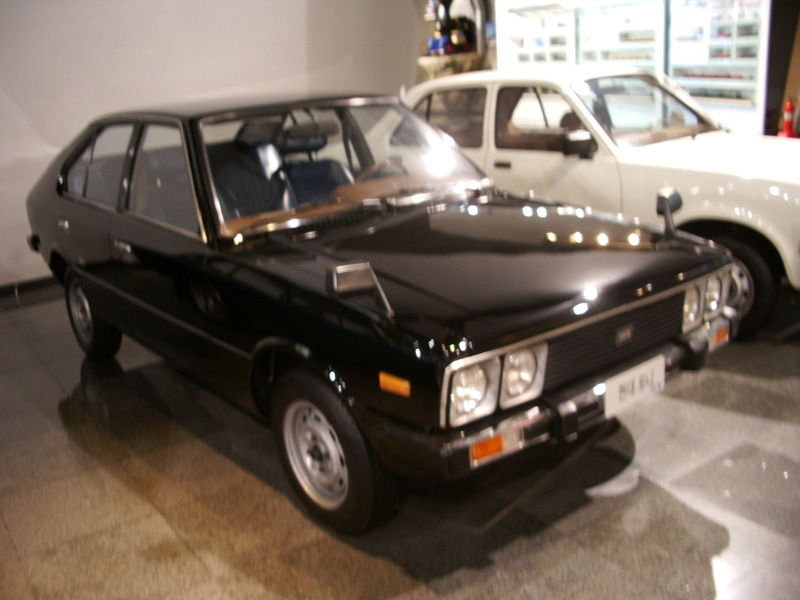
Hyundai Pony 1.2
The Hyundai Pony holds an extraordinary place in automotive history as the first mass-produced South Korean car. Launched in 1975, it represented the beginning of what would become one of the world's largest automotive manufacturing industries. The Pony was not merely a car — it was an industrial and national ambition made real.
The Pony was a collaborative effort of remarkable pedigree. The body was styled by Giorgetto Giugiaro at Italdesign — one of the world's foremost automotive designers. The powertrain was based on Mitsubishi technology, with the 1,238cc Saturn inline-four engine producing 68 horsepower. The platform used a conventional front-engine, rear-wheel-drive layout with live rear axle.
The 1.2-liter engine was a Mitsubishi-designed unit that was simple, reliable, and economical. It was mated to a four-speed manual gearbox, providing adequate performance for the Pony's 850 kg curb weight. Fuel economy was excellent — a critical feature in the aftermath of the 1973 oil crisis.
Giugiaro's design was clean and modern for its era, with a distinctive fastback rear that was both practical and visually appealing. The two-box shape provided a spacious interior for a car of its external dimensions, and the hatchback variant offered useful cargo capacity. The styling was conservative enough to appeal to first-time car buyers but distinctive enough to establish a visual identity.
The Pony was primarily sold in the South Korean domestic market, where it was an immediate success. It also found export markets in Africa, the Middle East, South America, and eventually Canada (where it became Hyundai's first export model in 1984). The car was positioned as affordable, reliable basic transportation.
Production of the Pony ran from 1975 to 1990 across two generations. The original Pony established Hyundai as a credible automobile manufacturer and laid the foundation for the company's explosive growth in subsequent decades. Today, surviving Ponies are rare — especially in good condition — and they represent a fascinating piece of automotive history.
Extremely rare outside South Korea. Rust is a major concern. Mitsubishi-derived engine parts are available through Mitsubishi sources. Giugiaro-designed body panels are unique to the Pony. Documentation and provenance add significant value for this historically important car. Interior trim and glass are difficult to source.
Produced at Hyundai's Ulsan factory in South Korea from 1975 to 1982 (first generation). The Pony was the first mass-produced South Korean automobile. Total first-generation production exceeded 300,000 units.