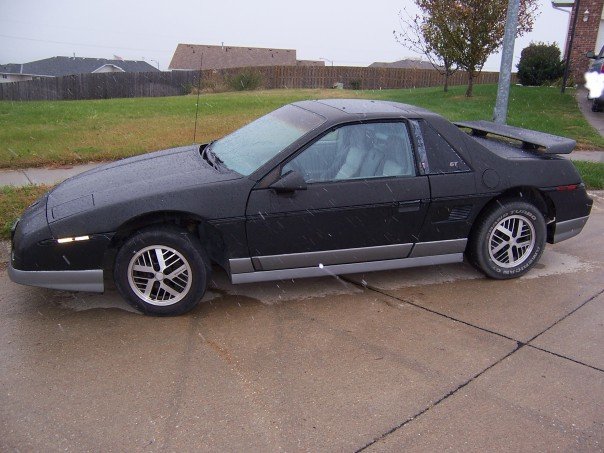
Pontiac Fiero GT
The Pontiac Fiero GT holds a unique and somewhat bittersweet place in American automotive history. As the only mid-engine production car ever built by a major American manufacturer, the Fiero represented a bold departure from Detroit convention. The GT variant, equipped with the 2.8-liter V6, addressed the original car's most serious criticism and hinted at the potential that the Fiero never fully realized before its premature cancellation.
The 2.8-liter 60-degree V6, producing 140 horsepower, transformed the Fiero's character. The original 2.5-liter Iron Duke four-cylinder had been woefully underpowered, turning the mid-engine layout's promise into an unfulfilled tease. The V6's additional power and significantly smoother operation made the Fiero GT a genuinely enjoyable sports car that could exploit its exotic layout.
The mid-engine configuration placed the engine behind the cabin and ahead of the rear axle, providing the kind of weight distribution that European sports car builders had long championed. The result was responsive turn-in, a natural rotation in corners, and a balanced feel that was completely unlike any other American car. The V6's torque delivery through the rear wheels gave the Fiero GT a driving experience more reminiscent of a Fiat X1/9 or Toyota MR2 than a Corvette or Camaro.
The GT package included specific body panels that differentiated it from the base Fiero. The more aggressive lower body cladding, rear spoiler, and functional air intakes gave the GT a purposeful appearance that suited its sporting pretensions. The overall design, while dated by modern standards, was considered attractive and contemporary when new.
The suspension used MacPherson struts at all four corners -- an unusual arrangement for an American car but appropriate for the Fiero's mid-engine layout. The GT received stiffer springs and shock absorbers, a larger rear anti-roll bar, and wider tires that improved grip and handling response. The steering was unassisted rack-and-pinion, providing direct feedback and moderate effort.
Braking used front disc and rear drum brakes -- an arrangement that was adequate but not outstanding for the car's performance level. The front-biased brake balance was appropriate for the mid-engine layout's weight distribution.
The interior was a Pontiac design that combined sports car ambiance with typical GM materials and switchgear. The instrument panel featured a prominent tachometer, and the GT-specific seats provided improved lateral support. The cabin was snug for two, with minimal storage space -- a typical mid-engine compromise.
The Fiero's greatest tragedy was its cancellation after just five model years (1984-1988). By the final year, Pontiac had resolved many of the car's early quality issues and was preparing a significantly updated version with improved suspension geometry, more power, and better build quality. Corporate politics and financial concerns killed the program before this potential was realized.
Today, the Fiero GT has developed a dedicated enthusiast following. The car's unique layout, affordable entry price, and strong modification potential have created a vibrant community of owners and builders. The 1988 model year, with its improved suspension, is generally considered the most desirable factory Fiero.
Check for engine compartment fire damage (early four-cylinder Fieros had a recall for connecting rod failures that could cause fires; the V6 GT was largely unaffected but verify). Inspect the space frame for rust and accident damage. The plastic body panels don't rust but can crack and fade. V6 engine should run smoothly; check for intake manifold gasket leaks (a known GM V6 issue). The 1988 model year is most desirable due to its improved suspension.
Built at the Pontiac Fiero Assembly Plant in Pontiac, Michigan -- a dedicated facility built specifically for Fiero production. The V6 GT was introduced for 1985 and continued through the end of production in 1988.