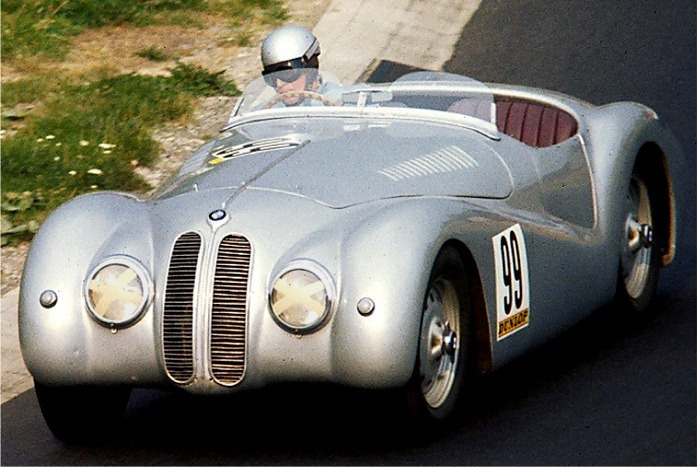

Germany vs UK — 1936 vs 1929
| 328 Roadster Mille Miglia | International Le Mans | |
|---|---|---|
| Horsepower | 80 hp | 70 hp |
| Torque | 101 lb-ft | 77 lb-ft |
| Engine Size | 1,971 cc | 1,495 cc |
| 0-60 mph | 10.0 sec | — |
| Top Speed | 96 mph | 90 mph |
| ¼ Mile | 17.5 sec | — |
| Weight | 1,830 lbs | 1,905 lbs |
| Wheelbase | 2,400 mm | 2,591 mm |
| Length | 3,900 mm | 3,962 mm |
| Units Produced | 464 | 130 |
| Value (Excellent) | $2,500,000 | $900,000 |
| Collectibility | 10/10 | 9/10 |
| Rarity | 10/10 | 9/10 |
Two outstanding machines, each with compelling strengths. The 1936 BMW 328 Roadster Mille Miglia excels in more power, higher top speed, stronger collectibility, while the 1929 Aston Martin International Le Mans stands out for greater rarity, better value. The best advice? Drive both if you can, then follow your instincts.
Putting the 1936 BMW 328 Roadster Mille Miglia against the 1929 Aston Martin International Le Mans is a comparison that enthusiasts have debated for decades. Each car reflects distinct design philosophies shaped by different automotive cultures — Germany versus UK. On paper, the two are remarkably close in power output, with the 1936 BMW 328 Roadster Mille Miglia producing 80 hp and the 1929 Aston Martin International Le Mans delivering 70 hp. Under the hood, the contrast is notable: the BMW 328 uses a Inline-6 OHV displacing 1,971 cc, while the Aston Martin International relies on a Inline-4 SOHC with 1,495 cc. The 1936 BMW 328 Roadster Mille Miglia claims a higher top speed at 96 mph compared to 90 mph. Rarity plays a significant role here — with only 130 units built, the 1929 Aston Martin International Le Mans is considerably scarcer than the BMW 328's 464 examples. On the collector market, the 1936 BMW 328 Roadster Mille Miglia commands a significant premium over the 1929 Aston Martin International Le Mans, reflecting differences in prestige and rarity.